Step Into Rubicon’s Virtual Classroom
By Greg Reimer December 15, 2021

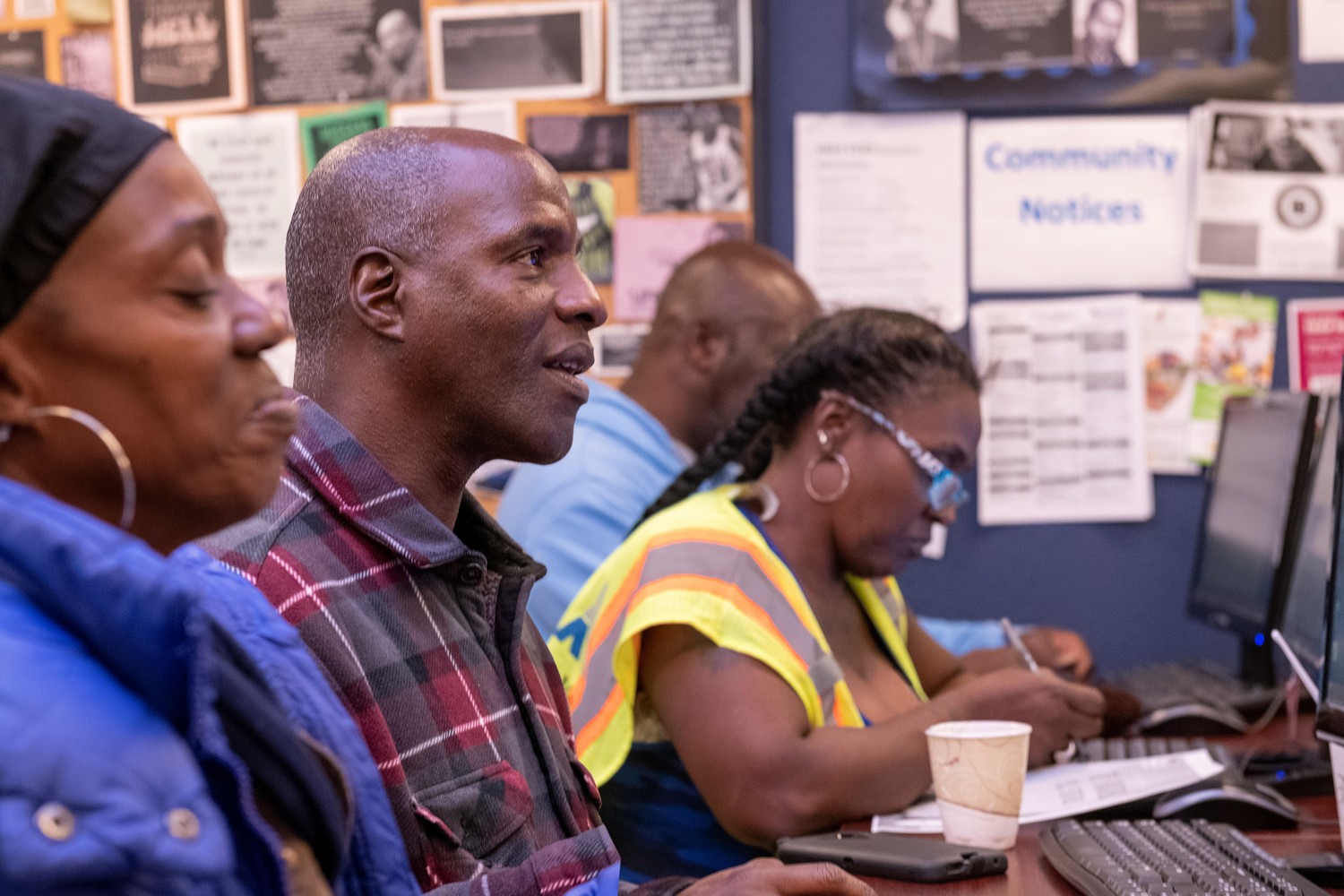
Image: Rubicon participants using computers on-site during a program in 2018. Now, participants can connect to programs online through Zoom and Google Classroom.

With the onset of the COVID-19 pandemic last year, Rubicon was quick to pivot in order to provide our services to as many participants as possible, despite having to close our office doors. One way that Rubicon transitioned to providing virtual services is by utilizing Google Classroom.

If you’re unfamiliar with Google Classroom, it is an online hub that allows users to view content as well as complete assignments. Rubicon has found Google Classroom to be a strong fit to ‘house’ all of our Foundations workshops, which provide information on financial, employment, and wellness skills.

Rubicon also offers our Foundations workshops virtually via live Zoom sessions. However, due to those being at a scheduled time every day, Rubicon realized that offering the information on Google Classroom could expand our reach to more participants, who could complete the workshops on-demand as their schedules allowed. It's also been useful for participants who may miss one or two of the live Zoom workshops, as they can make them up by accessing the information on Google Classroom. “Participants that are working or have children and unable to get child care, are enjoying being able to log on to Google Classroom at their convenience,” says Rubicon Impact Coach Ruben Cantu. Rubicon further supported our participants by providing free laptops and Wi-Fi hotspots to those that needed them to access Google Classroom.

Participant feedback overall has been positive, as many are grateful for the flexibility that Google Classroom’s on-demand access provides. Participant feedback wasn’t always so solid, however; early on, many participants became frustrated because of their lack of familiarity with Google Classroom and their confusion over accessing all of Rubicon’s uploaded workshop material.

Rubicon responded by creating a new employment position, technical assistant, who would serve as a help desk or support line for participants who had questions navigating Google Classroom. And even better, this position is staffed by a few tech-savvy Rubicon participants. James Toalu, one of the technical assistants, explains that “once participants understand how to navigate Google Classroom, they are completing the workshops with ease.”

By having the Foundations workshop material on Google Classroom and offering live workshops via Zoom, Rubicon has been able to maintain providing our valuable services and information to our community during the COVID-19 pandemic. Furthermore, Rubicon’s positive experience with Google Classroom has us believing that it's here to stay. Its on-demand ability makes it so convenient and a better option for many of our participants than scheduled programming. Thus, even when we’re back to offering our workshops fully in-person in the office, the Google Classroom option is likely to remain.

What the future holds is unknown, but what we do know is Rubicon is committed to providing our services and effectively reaching participants, one person and one laptop at a time. 
Read More

Rubicon Programs to Distribute Toys and Food to 200 East Bay Families

By Sabrina Paynter December 15, 2021

Rubicon Programs will distribute hot meals and toys to approximately 200 program participants and their families on Saturday, December 18 and Tuesday, December 21, 2021 at four of its East Bay locations. This marks the 12th year that the organization has provided gifts and food as part of a winter holiday celebration.

Rubicon’s Chief Program Officer Donté Blue says the giveaway events are a reminder to community members that they matter. “Since the beginning of time, sharing a warm meal has symbolized caring for another’s well-being in the same way a holiday toy brings joy – because someone cared enough to think about you,” Blue says. “We want our participants to know Rubicon is thinking about them and their well-being during this holiday season.”

A group of nearly 20 people across the sites, comprised of Rubicon employees and Participant Advisory Board members, will be on hand to distribute the toys and meals. Due to COVID-19 safety concerns at last year’s event, meals were not provided at the toy distribution, making this year’s festivities a welcome return to tradition for both Rubicon staff and participants.

Director of Community Based Programs Rhody McCoy looks forward to interacting with participants and their families at these events each year. “Rubicon considers the community we work in family,” McCoy says. “We are pleased and honored to be able to invite people to our sites, host these special events and participate in each family's holiday celebration and share the joy!”

Ron Thomas, Site Manager for Rubicon’s Concord location, secured the toys through the Marine Toys for Tots Foundation’s local campaign in Concord, CA, known for its annual collection and distribution of toys during the holiday season. In total, Rubicon distributes 400-500 toys each year in partnership with the Marine Toys for Tots Foundation and Centerforce, which receives additional donations through community churches.

“Every child needs a village. Rubicon is that village for families in the community,” Thomas says.

Participants who are enrolled in Rubicon’s programs have already received their invitations to the events. The food and toy distributions will take place at the following locations and times:

Saturday, December 18, 2021, 12:00 – 2:00 pm, Reentry Success Center

Tuesday, December 21, 2021, 4:30 – 6:00 pm Rubicon Antioch, Richmond, and Concord locations

Read More

Being the change you want to see

By Greg Reimer November 19, 2021

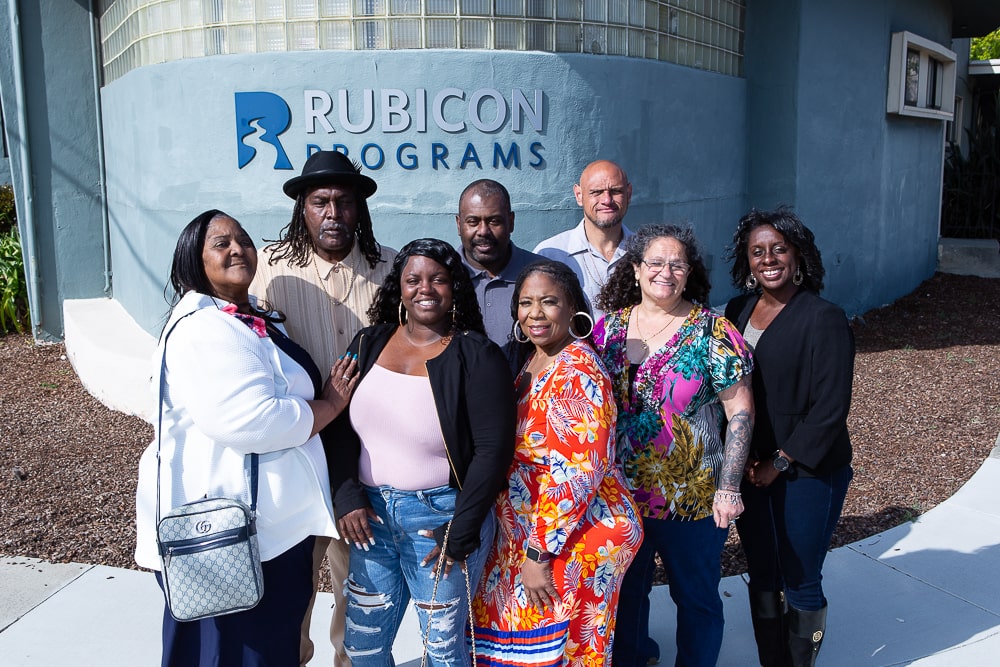
Seven members of the PAB with Alisha Semplar in front of the Rubicon building in Richmond, CA
Members of the PAB with Rubicon's Community Connections Program Manager Alisha Semplar, far right, in early 2021.

At Rubicon, we understand that participants are why we’re here, and we want the participant voice to be deeply involved in our decision-making process. One way we’re tapping into and developing the participant voice is the Participant Advisory Board (PAB). The PAB is an organized group of Rubicon participants with the purpose of enhancing Rubicon’s services and our community. The PAB was just a model on paper until October of 2018, when Alisha Semplar joined Rubicon as our Community Connections Program Manager. Thanks to Alisha’s desire to “put the rubber to the road,” the PAB soon shifted from theory into reality.

Alisha says she “sees the diamonds in every participant” and desires to bring out “their shine” for all to see. In launching the PAB, she sought for it to help participants build their self-efficacy through leadership development and active involvement in helping their community. Alisha loves to see how the PAB. “creates leaders and change agents.” “PAB members are leaders in their communities and drivers of change that are constructing a pathway to success to break the cycle of poverty,” Alisha proudly proclaims. Alisha occasionally helps organize and facilitate PAB procedures, but the PAB is mostly run by the participants themselves.

Alisha feels the PAB “creates a conduit” for Rubicon participants to develop their leadership skills, grow their personal networks, and contribute to making changes that will help their community. The PAB meets once a month, where members vote on action items to determine which ones resonate most with their desired community impact. Examples of PAB action items of the past include creating a voter guide, partnering with Healthy Richmond, working with The Safe Return Project, and contributing to the Contra Costa County’s Office of Racial Equity and Social Justice. PAB members also sit on various public committees to help guide the work and provide a voice for their community.

The PAB is also involved in civic activities, including making recommendations for legislative items affecting the community, such as housing and environmental laws. “These are issues directly affecting PAB members' lives, and we know some communities are disproportionately impacted, so the PAB voice is vital”, Alisha says. Alisha adds that discussions at PAB meetings “are guided by the temperature of society,” meaning whatever issues are relevant to the members are those discussed. But they’re not only discussed; the PAB is focused on creating solutions and “taking actions to better the communities directly impacted,” states Alisha.

PAB members are also heavily involved in the structure of Rubicon. PAB members are asked to be a part of interview panels for potential Rubicon employees. Rubicon wants to get the participant perspective on potential hires, so PAB member feedback is invaluable. Some PAB members are also involved in the Program Implementation Committee (PIC), which is composed of program directors and managers. The PIC evaluates and updates Rubicon’s practices and model; similar to the interviews, PAB members' input is critical.

When recruiting new participants for PAB, Alisha mentions that PAB members share a strong desire for social action and change in their community. PAB members are focused on improving the lives of their fellow community members while at the same time experiencing their own personal growth. Alisha emphasizes that "PAB empowers participants to be the change that they are seeking.”

Read More

Rubicon Career Advisor Connects Policy and Practice Through Prestigious Fellowship

By Sabrina Paynter November 16, 2021

The COVID-19 pandemic has given many workers, especially those working remotely for the first time in their careers, a chance to look at their lives from a fresh perspective in what some are calling the “Great Reassessment.” For Rubicon Career Advisor John Cunningham, he saw an opportunity for growth.

“Working from home and the pandemic had me rethinking what I was going to do with all of this time I was going to have,” Cunningham said. “I saw the 8 minute and 46 second video of George Floyd, and I felt kind of helpless because I saw that being myself or one of my children. And I just kept hearing all of this rhetoric around how these types of things continue to happen and have historically been a part of the narrative between policing and black men and women and people of color in general in America, and I was like, ‘Man, I need to do something, I can’t just sit here and not do anything.’”

After consulting with people in his network, Cunningham received a recommendation from Pat Mims, Director of the Reentry Success Center, to connect with Project Rebound. Their support led Cunningham to enroll in a summer math camp, where he was the only student from the initial cohort who stayed through the entire series of classes.

The experience added to his desire to learn more. “I think it really showed me that I had the ability to accomplish things in an educational setting that I had never accomplished before, and it gave me a lot of confidence,” Cunningham said. “So I decided to give it a shot and go for a degree.”

Cunningham enrolled in classes at San Francisco State University (SFSU) and immediately began looking for ways to apply his learning outside of the classroom. He participated in the SFSU President’s Leadership Fellows Program, where he enhanced and added to the job-readiness skills he uses to support Rubicon participants in his role as a Career Advisor. He then set his sights on the Willie L. Brown, Jr. Fellowship. After a rigorous application and selection process, he was selected to participate as one of ten fellows for the Fall 2021 semester.

“I was interested in continuing the work I do with Rubicon, but expanding that into an understanding of how legislation and policies are created,” Cunningham said. “Seeing the whole process from beginning to end, reading these reports and seeing these recommendations and how they put all of this together to make legislation out of it—that’s the part that’s beneficial to me. It takes me out of the hands on and gives me a behind-the-veil experience on how government comes to some of the decisions that they come to.”

As a Willie L. Brown, Jr. Fellow, Cunningham works directly in government as an intern for Shamann Walton, President of the San Francisco Board of Supervisors. Cunningham participates in three primary focus areas in this role: closure of the San Francisco juvenile hall, a project that will be finalized in December; the African American Reparations Advisory Committee, a group created by the Board of Supervisors that is assessing what reparations could look like for the city; and the Racial Equity Task Force, which looks at spaces in the city to ensure that people are treated equitably.

For Cunningham, the opportunity to create systemic change is one that he encourages others to join in. “Being formerly incarcerated myself, I love to see those systems of oppression dismantled and destroyed,” Cunningham said. “The one thing I would tell people is that they always have a section in every open meeting to the public where you can make comments. So many people do not take advantage to express their disagreement or support for whatever these committees are doing. The people who are going to be affected by the decisions do have a voice in the process, but we don’t take advantage of it.”

After his fellowship ends next month, Cunningham is looking forward to pursuing his degree in Race and Resistance Studies from SFSU while continuing his work with Rubicon. “Honestly, the degree is great,” Cunningham said. “But as I was going through the first semester, I realized that the degree—the piece of paper—was not really that important to me. Obtaining the knowledge and allowing me to network and be in spaces where I would be effective is what matters.”

Read More

Measure X Community Advisory Board Proposes Funding Priorities Aligned with Rubicon’s Work

By Sabrina Paynter October 7, 2021

CONTRA COSTA COUNTY, CALIF., OCTOBER 7, 2021 … The Contra Costa County Measure X Community Advisory Board (CAB) voted last evening to accept a report listing first-year recommended funding priorities for submission to the Board of Supervisors. The list contains five goal areas supported by 43 strategies, many of which are aligned with Rubicon’s comprehensive programs.

Community-based services—including those that Rubicon provides such as mental health support, training and employment, and reentry support—are prioritized strategies in all of the goal areas highlighted in the report. The strategies were each rated as a top priority by at least 51% of voting board members at the September 8, 2021 meeting.

Michelle Stewart, District 5 CAB member and the Antioch Site Manager for Rubicon Programs, says the decisions on how to prioritize the funding recommendations were challenging. “It was really tough, because we had a bumper crop of presentations from numerous people, and it’s very difficult to make these kinds of decisions because everything is important,” Stewart said. “Do you prioritize seniors over children? Do you prioritize a lab for the regional hospital over mental health services? Do you prioritize housing over transportation? It’s all important, and it makes a difference in the quality of life for people and their ability to survive.”

In order to ensure that the CAB heard a sufficient variety of voices in the discussions, a total of 94 subject matter experts, including five from Rubicon, presented on a variety of community needs, issues, and topics during CAB meetings that were held over four months. Members of the public also gave their input by writing in and attending meetings, with some community members appearing at the virtual meetings nearly every week.

Although public attendance at the meetings grew over time, Stewart thinks there are more residents to hear. “We did get a lot of public comments, but we could get a lot more,” Stewart said. “I would have liked to have seen more residents participate and make comments about what is needed in their communities, in their neighborhoods, and what are their concerns.”

The recommendations in the report are not tied to specific dollar amounts. Instead, the CAB assigned rankings to each strategy to help the Board of Supervisors understand the priority levels to determine funding allocations. The rankings are based on the relative popularity of each strategy based on the September 8 vote, with community-based mental health services, establishing a County Office of Racial Equity and Social Justice, expanded comprehensive healthcare for the uninsured, and tenant legal services among the top ten.

Stewart cautions residents not to get discouraged if they don’t see their priorities at the top of the list. “This is just the first year. Just because you weren’t prioritized now doesn’t make you not a priority,” Stewart said. “We’re going to make our recommendations in the next couple of weeks, we’ll have a few weeks off, and then we’re right back at it. So just continue showing up.”

According to the report, Measure X is a countywide, voter-approved half cent tax that is intended “to keep Contra Costa’s regional hospital open and staffed; fund community health centers, emergency response; support crucial safety-net services; invest in early childhood services; protect vulnerable populations; and for other essential county services.” The CAB was established in February 2021 and is made up of 17 members—10 supervisorial district appointees and 7 at-large members—who serve two-year terms with a maximum limit of six years total. The CAB currently meets Wednesdays at 5:00 pm on Zoom.

Read More