
Blog

Blog

Let’s Stop the Looming Tidal Wave of COVID Evictions

By Rubicon Author June 30, 2020

As Bay Area counties put their plans to reopen on hold amidst a spike in Coronavirus cases, we are all doing our best to keep our friends and family healthy. Yet even as we monitor infection rates and remain vigilant about our own safety, we cannot turn our attention away from the devastating economic impact of the pandemic on our most vulnerable people and communities. And we must exhort our politicians to make decisions that protect the wellbeing of those disproportionately affected by COVID-19.  

At Rubicon, as we continue to deliver our services remotely, we have seen the strength and resilience of our participants and communities. At the same time, we have heard firsthand about jobs lost, hours cut, and anxiety over where the next rent payment will come from. With so many East Bay residents financially impacted by the pandemic, we can expect a tidal wave of evictions as soon as temporary protections recede. We need long-term solutions that keep families home—not short-term approaches that kick the can down the road.

AB 1436, a new state bill, will keep community members in their homes and bolster California’s economic recovery by keeping more of us safe and healthy.

Click here to support AB 1436, which makes sure families who rent will not be evicted because they are behind on their rent due to COVID-19.

Without action, we will be condemning over a million Californians to impending displacement or homelessness. AB 1436, the COVID Eviction Prevention and Housing Stability Act of 2020, helps our most impacted renters transition out of emergency and into recovery, while giving landlords a path to recuperate that lost income.

Take 3 minutes NOW to email, tweet at, and call key Senators to urge them to vote YES ON AB 1436!

Unfortunately, not all state legislators feel the urgency to act. They have to know that our current eviction laws were not written with a global pandemic in mind, yet they are waiting this one out. That’s unacceptable!

We all want a speedy recovery, but without a plan for the millions of California renters who are vulnerable to eviction, that recovery will not come as quickly as we all hope.

Contact your Senator NOW to urge them to vote YES on AB 1436!

We can do this - take action now!


Jane Fischberg, President & CEO

Carole Dorham-Kelly, Chief Program Officer

Kelly Dunn, General Counsel & Director of Legal Services
Read More

We Demand Justice

By Rubicon Author June 2, 2020

Rubicon Stands Alongside our Partners in Demanding Justice


Rubicon stands with our allies at the local, regional, and national levels in demanding an end to unjust and racially motivated actions by law enforcement officers. For hundreds of years, state sponsored entities and private citizens have been executing Black men, women, and children. In May 2020 alone, Ahmaud Arbery, Breonna Taylor, George Floyd and Tony McDade -- as well as others whose killings did not make the national news -- joined that awful legacy. State sanctioned violence includes not only the actions of police, but also national guard, jails and prisons, and other public institutions charged with public protection.

We demand justice for those whose lives have been cut short. They could have been a Rubicon participant, employee, or a member of our Board of Directors. Our African American participants carry daily the trauma of being African American in a nation where their very identity makes them vulnerable to being the target of violence. We talk with participants in our workshops about structural causes of poverty – that we live in a nation founded on white supremacy and systems of inequality.

COVID’s disparate and traumatic impact on Black people and other people of color is a current manifestation of the structural racism that tolerates state sanctioned violence against people of color. We are unwilling to perpetuate the national disregard for African American lives and senseless killings of our citizens, the very people upon whose backs and free labor this country was built. We demand the same right to life, liberty, and the pursuit of happiness for African Americans that White people continue to enjoy. These should not be privileges for some; these are rights for all.

Just as we do not condone this nation’s historical looting -- the First Nation’s people and land, African American bodies for labor, or African American ideas without credit -- we do not condone violence as a means to any end. And, we amplify Dr. King’s forewarning that “A riot is the language of the unheard.”

Rubicon's unwavering commitment to justice and equity fuels our responsibility to use our collective voice. We will galvanize our communities to engage in the electoral process to directly impact local, state, and national policies and priorities. We urge elected officials to hold accountable law enforcement officers and criminal justice systems that engage in unlawful and unjust practices.

Join us in these actions:

  1. Sign cards to the families of Ahmaud Arbery, Breonna Taylor, George Floyd, and Tony McDade. You can send a message of support here, until this Friday, June 5th at 12 noon.
  2. Consistent with our value of humility, we urge you to support actions by our power building partners.
  • RYSE -- immediate action to protect funding for services to children and youth in Richmond. Contact the Richmond City Council today to advocate that they preserve funding for Kids First (Vote NO on Agenda Item J-3).
  • Safe Return Project -- formerly incarcerated residents working to strengthen the relationship of people coming home from incarceration with the broader community. Join Safe Return Project Thursday, June 4th, 2 pm PST for #blackhurtmatters a Call to Action convened by those impacted by criminalization, violence, and Faith Leaders.

We are grateful to you, our community, for joining us in advocating for changes to build a society that lives up to its stated value of justice. May we all have safety, health, and wellness during this especially painful time.

Read More

Health, Healthcare, and Socioeconomic Barriers Related to COVID-19

By Rubicon Author May 13, 2020

Written by: Jasmine Penney

Historically, communities of color have always faced disparities when it comes to healthcare and the socioeconomic ladder. When enacted, the Affordable Care Act (ACA) was put in place to tackle some of those issues. Unfortunately, even with laws like the ACA in place, minority communities still continue to lack the necessary resources that are needed to combat (1) shorter lifespans, (2) common diseases, (3) and limited access to quality healthcare (due to both availability and financial restrictions).

During COVID-19, we continue to see the effects of both the failed healthcare system and economic system for communities of color. According to an aritcle from the Kaiser Family Foundation, in states such as Louisiana and Illinois, blacks make up between 32%-39% of the total population, yet are 56%-70% of the confirmed deaths due to COVID-19. Let that sink in: sounds pretty familiar to statistics related to the criminal justice system.

By watching the news and looking at data, it is clear that this outbreak has presented financial burdens on many families all around the country, and the world. However, the amount of minority families facing challenges on multiple tiers continues to be disproportionate. The first reason is due to the socioeconomic barriers that continue to keep minorities at the bottom of the ladder, and how that has played a role during the COVID-19 pandemic. Something else we have to take into consideration is the fact that the uninsured have a hard time accessing care or testing: people of color make up a large portion of the uninsured population. Lastly, we also have to look at the effects of COVID-19 on individuals with preexisting health conditions, and how minorities are the main carriers of a lot of common diseases such as heart disease, high blood pressure, etc.

Socioeconomic Barriers

While we can jump right into healthcare disparities since the virus is a health-related issue, it is just as important to acknowledge the disparities as it relates to socioeconomic status in minority communities. For people in the service industries, COVID-19 has forced their hours to be reduced, jobs eliminated, and in some cases, businesses closed. Additionally, for anyone who works in essential service industries such as grocery stores, they have a higher risk of contracting the virus due to the amount of people they come in contact with on a daily basis. Nearly 25% of Blacks and Hispanics are employed in service industries, compared to Whites at 16%. Over 25% of Blacks, Hispanics, and American Indian & Alaskan Natives already have an income that puts them below the poverty line, so losing a job or getting their hours reduced puts them at a greater risk of not being able to pay bills or feed their families (KFF); Less than 17% of Whites face this issue.

One of the ways we have been told to combat attracting COVID-19 is to eat more immune-boosting foods, and take immune-boosting vitamin supplements. However, if your income is being lessened, you may not be able to afford those vital items and instead settle for the whopping number of fast food restaurants that are so heavily saturated in your neighborhood. It makes us question exactly where minorities are supposed to catch a break.

Still related to socioeconomic hardships, we also have to consider living situations when it comes to vulnerability to COVID-19. In cities such as New York, the virus was so contagious due to crowded living environments. In other industrial areas, immune systems are already triggered due to the constant release of toxic fumes into the environment. In fact, some of those chemical plants are located right here in the Bay Area. People of color make up 56% of the population in urban cities, while Whites make up the majority in rural and suburban areas. Something else to note: 38%-41% of Blacks, Hispanics, and Asians live near multi-familiy units, where Whites only make up 23% of the folks who live in those kinds of environments. Like the cases in New York, living in close proximity to one another has caused a major influx in COVID-19 cases due to them not having space between one home to the next (NY Times). 

What About the Uninsured and Individuals with Pre-existing Health Conditions?

Not only do minority communities deal with socioeconomic barriers, but they are also less likely to have health insurance. This presents a problem with COVID-19 because they have a hard time getting testing. Although Congress passed legislation for free testing even if you don’t have health insurance, communities of color still face challenges because they are unaware where they should go to get tested since they don’t visit the doctor often. Additionally, they may be unaware that testing is free, and also wouldn’t be able to afford the necessary care if they were to test positive for coronavirus. 

Different minority groups have many underlying health issues that are common within their racial groups. We learned early on when the pandemic broke out that the folks most vulnerable to this infection would be those with preexisting conditions such as diabetes, heart disease, asthma, lung disease, and those with immune-compromised systems due to HIV/AIDS and cancer treatment. Blacks and American Indian & Alaskan Natives are as much as 2x more likely to  have conditions such as heart attacks, asthma, and diabetes compared to Whites. For the youth, Black and Hispanic children are more likely to become obese compared to their White counterparts (KFF). If these all fall in-line with the most susceptible to the virus, where does that leave our minority communities?

Call to Action

As community service members, it is our job to aid in the advancement of minorities when it comes to health, healthcare, and socioeconomic barriers. We see the effects every day and have first-hand experience of the negative impact it has on the individuals we serve. These stats are not just here to showcase information, but to paint a picture of the constant uphill battle that communities of color continue to face. Once the vision is painted, we are then challenged to do something to help the issue and to help take the burden off those in our own backyards. Let’s continue to band together, and fight the good fight. Our communities need us now more than ever!
 

Read More

Let’s Talk About Equitable Wellness

By Rubicon Author April 29, 2020

Written by: Jasmine Penney

I first want to start off by sending many good wishes to you and your families during this pandemic. Despite what is going on around us, let’s continue to look out for one another and build community.

April is National Minority Health Month. 

According to the National Institute on Minority Health and Health Disparities, this month-long event was created as an “effort to raise awareness about health disparities that continue to affect racial and ethnic minority populations.” Although we are currently in a nationwide shelter-in-place due to COVID-19, there are still ways to advance this month’s theme of “Active & Healthy” and promote emotional and mental wellness right inside of our homes. In fact, the Office of Minority Health and the US Department of Health and Human Services provides information on different ways we can all participate in the #ActiveandHealthy campaign, while still adhering to social-distancing guidelines.

What causes health inequities?

Health inequity stems from root causes that I have organized into three clusters:

  1. Structural inequities that organize the distribution of power and resources differentially across lines of race, gender, class, sexual orientation, gender expression, and other dimensions of individual and group identity.
  2. The unequal allocation of power and resources—including goods, services, and societal attention—which results in unequal social, economic, and environmental conditions also referred to as the determinants of health.
  3. Unconscious bias in healthcare settings. Many non-medical factors influence medical decisions, including: a patient’s style of dress; race, ethnicity, or gender; insurance status;  and the clinical setting (i.e. what is perceived as “bad neighborhood” vs. “good neighborhood”). Evidence shows that medical conclusions can be based just as much on who a person is as on the symptoms they present. This is especially dangerous in healthcare, where decisions can mean life or death.

Faced with these challenging external factors, if people of color could get the time off to see a medical professional, many may choose to ignore or hide symptoms in order to protect their physiological safety. They are then left with the long-term cumulative effects of structural inequity and not seeking help. 

So, if someone needs help, where are they supposed to go? Who are they supposed to trust? This is where Rubicon can be a positive social connection.

Wellness is a vital piece of Rubicon’s culture and program model. Rubicon works on interventions targeting root causes because we know those interventions hold the greatest promise for advancing health equity.  Additionally, we know that each of us is our own best advocate, and that together we can advance equitable community wellness.

I plan to continue sharing wellness information with our community, even beyond National Minority Health Month to help keep us all connected, healthy, and resilient during this pandemic, and beyond. I invite you to learn more about the #ActiveandHealthy campaign, so we can all be a part of the national change and learn about what we can do to battle inequities and support our health.

I look forward to hearing about how this information helps you in your day-to-day routine, and most importantly, learning and making strides as a community.  

To Your Wellness!


Next Up: Health, Healthcare, and Socioeconomic Barriers Related to COVID-19

Read More

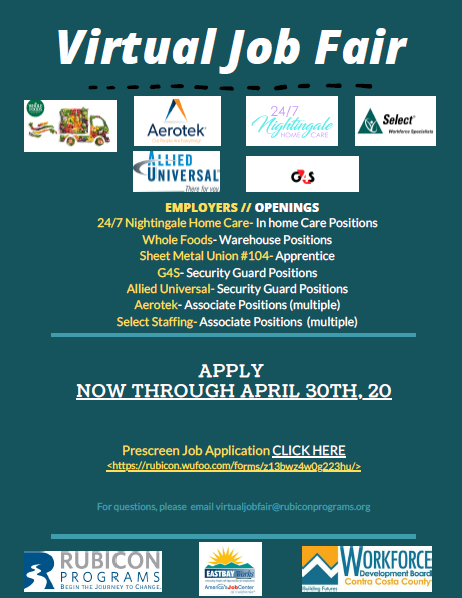
Virtual Job Fair—Now through April 30th

By Rubicon Admin April 22, 2020

Looking for employment? Rubicon Programs is hosting a Virtual Job Fair to connect candidates with job opportunities at participating employers.

Application Instructions: Interested parties need to apply here and upload a current resume by April 30th. Once complete, applicants will recieve a phone call to be screened for the positions they are interested in. All qualified applicants will receive a phone interview with an employer. 

For questions, please email virtualjobfair@rubiconprograms.org.


Apply Now!

Read More